

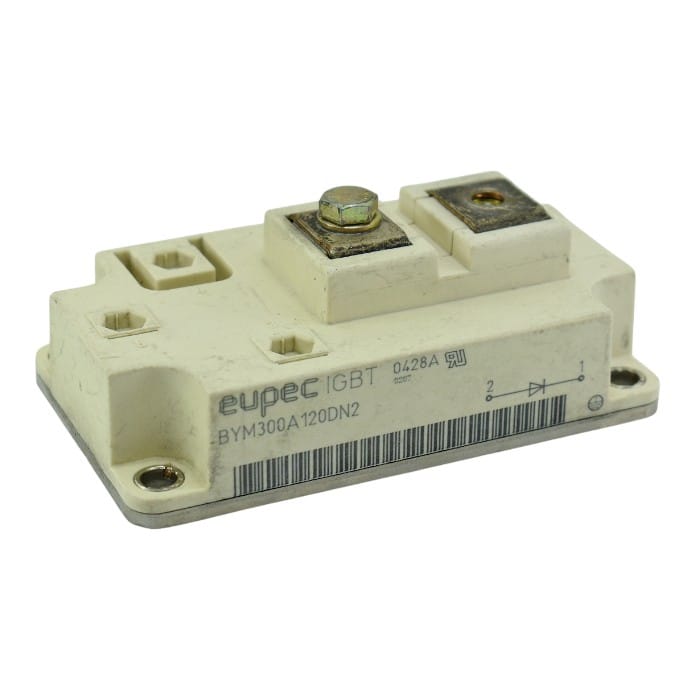



Eupec BYM300A120DN2 Fast Recovery Diode Module – 300A 1200V (Used / Tested)
The Eupec BYM300A120DN2 is a specialized power semiconductor module designed for high-frequency switching applications. Manufactured by Eupec (European Power Semiconductor and Electronics Company, now Infineon), this module is legendary for its thermal durability. Although the housing is labeled “IGBT” due to the shared mold used during manufacturing, the internal architecture and the schematic printed on the side confirm that this is a Single Fast Recovery Diode (Freewheeling Diode).

Condition and Verification module Eupec BYM300A120DN2
We understand the risks associated with buying used industrial electronics.
Status: Used / Pulled from working environment.
Cosmetic: The unit displays normal signs of industrial use, such as minor scratches on the plastic casing or oxidation on the copper terminals (Date Code: 0428A – Week 28, 2004). The baseplate remains structurally sound.
Testing Protocol: We perform a “Cold Check” using a professional multimeter before shipping:
Forward Bias: Confirms current flow from Anode to Cathode (Terminal 2 to 1).
Reverse Bias: Confirms high impedance (blocking voltage) to ensure the diode is not shorted.
Isolation: Verifies no leakage current between the electrical terminals and the copper baseplate.
Technical Specifications (Reconstructed from Architecture)
Part Number: BYM300A120DN2.
Manufacturer: Eupec (Germany).
Function: Fast Recovery Diode Module (Single).
Configuration: 2-Terminal device (Anode: Term 2 / Cathode: Term 1). Note: Small signal terminals are typically depopulated on this model.
Repetitive Peak Reverse Voltage (V_RRM): 1200V.
Average Forward Current (I_FAV): 300A.
Reverse Recovery Characteristics: Soft recovery to minimize EMI (Electromagnetic Interference).
Package: Standard 62mm industrial housing with Copper Baseplate.
Mounting: M6 Screw terminals for power connections.
Common Applications
The Eupec BYM300A120DN2 is engineered for circuits where fast switching speeds and low reverse recovery losses are critical:
Free-Wheeling Diode: Used in parallel with IGBTs in motor inverters to protect transistors from flyback voltage.
Brake Choppers: Snubber circuits in Variable Frequency Drives (VFDs).
Welding Power Supplies: High-frequency rectification in inverters.
Resonant Converters: Induction heating applications.
About the Brand: Eupec
Before its full integration into Infineon Technologies, Eupec was the European standard-bearer for high-power modules. Their devices are known for having generous thermal margins. Many technicians specifically seek out these older “White Module” Eupec parts because they often prove more robust in environments with “dirty power” or voltage spikes compared to newer, more sensitive silicon generations.
Frequently Asked Questions (FAQ)
Why does the case say “IGBT” if this is a Diode?
This is common with Eupec modules from the early 2000s. They used the same plastic housing mold for both IGBTs and Diode modules to save costs. However, the part number starting with “BY” (Diode) and the schematic symbol printed on the side (a single diode) confirm it is a Fast Recovery Diode module.
How do I connect this module?
Refer to the schematic on the side of the casing. Typically, Terminal 2 is the Anode (+) and Terminal 1 is the Cathode (-). Ensure you verify polarity before energizing, as connecting a diode in reverse polarity in a DC bus will cause immediate catastrophic failure.
Is this compatible with modern Infineon modules?
Yes, the BYM300A120DN2 is the ancestor of the modern Infineon DD300 series. It shares the same physical dimensions (62mm package) and mounting hole spacing, making it a drop-in mechanical replacement, provided the electrical specifications match your requirements.
Do I need to clean the terminals?
Yes. Since this is a used item from 2004, the copper terminals may have surface oxidation. We recommend cleaning the contact surfaces with a fine abrasive pad (like Scotch-Brite) and contact cleaner to ensure low electrical resistance and prevent overheating at the connection point.



Valoraciones
No hay valoraciones aún.